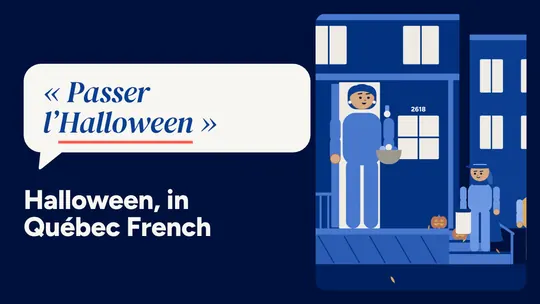
Expression library Passer l’Halloween: the French of Halloween in Québec Familier Long video, 8 min. Published Oct 29, 2026.
Play 8 min , the long video Passer l’Halloween: the French of Halloween in Québec, captions on Captions on
Watch on YouTube
Answer in the YouTube comments : Which Halloween word will you keep?
The French of Halloween in Québec: « passer l’Halloween » (and « courir l’Halloween » ), why Québec says « l’Halloween » with the article while France says « Halloween » , « Joyeuse Halloween » in the feminine, « un costume » and « se déguiser » , « une citrouille-lanterne » , « épeurant » , « des bonbons » and « des friandises » , and « reporter » , for the years Halloween moves. Then a quick quiz.
Transcript
Transcript × What’s said in the video, line by line. The narrator speaks English.
Julie « Joyeuse Halloween! Wow, une sorcière pis une citrouille! » Julie « Servez-vous, les enfants! » Narrator October thirty-first in Québec: costumes, a bowl of candy at every door, and one phrase you’ll hear on every street: « passer l’Halloween » . Let’s learn the French of Halloween in Québec, where the holiday came from, and how it’s different from France. Narrator In Québec, kids don’t just celebrate Halloween. They « passent l’Halloween » . Narrator Usito, the Québec dictionary, defines it simply: making the round of the houses, in costume, collecting treats. Narrator You’ll also hear « courir l’Halloween » : literally, to run Halloween. A Cégep teaching sheet, citing Québec’s language office, calls both typically Québec. Jacob « Les enfants vont passer l’Halloween à quelle heure? » Julie « Dès qu’il fait noir. » Narrator « Dès qu’il fait noir » : as soon as it gets dark.Narrator Notice the little word in front: « l’Halloween » . In Québec, it takes the article: « C’est l’Halloween! » Narrator The h is silent, so the article shrinks to l, apostrophe. Narrator And it’s feminine. Québec’s language office writes « Joyeuse Halloween » : joyeuse, not joyeux. Julie « C’est l’Halloween samedi! Joyeuse Halloween! » Jacob « Joyeuse Halloween à toi aussi! » Narrator In France? No article: « C’est Halloween » . More on France in a minute. Narrator First, the costume. In Québec: « un costume » . Québec’s language office defines it as « un déguisement » , a disguise. You’ll hear both. Narrator To dress up: « se déguiser » . In Québec, you’ll also hear « se costumer » . Julie « Vous êtes déguisés en quoi? » Narrator « Déguisés en quoi? » : dressed up as what? Tonight’s answer: « une sorcière » , a witch, and « une citrouille » , a pumpkin.Julie « Une sorcière pis une citrouille! Vous êtes ben beaux! » Narrator « Pis » , for « puis » : and. « Ben beaux » : really cute.Narrator Next, the pumpkin. Hollowed out, with a face cut into it and a light inside: the language office’s term is « une citrouille-lanterne » . You’ll also see « une citrouille d’Halloween » . Jacob « On vide la citrouille à soir? » Julie « Oui! Avec un sourire épeurant! » Narrator « Épeurant » : scary. Even the Larousse dictionary marks that one as Québec.Narrator And if it scares you? « J’ai la chienne! » : I’m scared. That one has its own Short this week. Narrator At the door, kids collect « des bonbons » : candy. Police notices and the language office also say « des friandises » : treats. Narrator Police notices call the evening « la cueillette de bonbons » : candy collecting. Julie « Trois sacs de bonbons, c’tu assez? » Jacob « Ben voyons, on va en manquer! » Narrator « C’tu assez? » : is it enough? « C’tu » is « c’est-tu » , said fast.Narrator One tip the Sûreté du Québec, the provincial police, repeats every year: don’t eat a candy if its wrapper is already open or punctured. Narrator And what do kids say when the door opens? Sources don’t agree. You’ll hear « Joyeuse Halloween! » , or just « Halloween! » , and sometimes « Bonbons, s’il vous plaît! » Narrator And a bit of history. In the 1920s and 30s, Montréal newspapers reported children at the door asking for « Charity » . Clippings from the 1950s say kids in Québec shouted « charitie! » . Narrator The name is English. Halloween is short for « All Hallow Even » : the eve of All Saints’ Day, « la veille de la Toussaint » . Usito’s first record of the word is from 1838. Narrator In the ninth century, the Church set the feast of all saints on November first. The day of the dead follows, on the second. Narrator Older still, in Ireland, the festival of Samhain marked the end of the harvest. People carved lanterns out of turnips. In America, Irish families switched to pumpkins. Narrator Irish and Scottish immigrants brought Halloween customs to Canada in the eighteen hundreds. The first carved pumpkin was reported in Kingston, in 1886. And the words trick or treat first show up in 1927, in Lethbridge, Alberta. Narrator The first Halloween costumes on record: Vancouver, 1898. And from 1955 to 2006, Canadian kids also carried UNICEF boxes door to door. Narrator French-speaking Québec came to it later. In 1996, a Université Laval historian said Halloween had become a celebration for the whole community only about ten years earlier. Narrator In France, it’s « Halloween » , with no article: « fêter Halloween » . Narrator Stores there promoted it in the late 1990s. In 2021, about a third of French households planned to go trick-or-treating. Narrator The bigger date in France is November first, « la Toussaint » , All Saints’ Day. It’s a public holiday, when families bring chrysanthemums to the graves. Narrator And in Mexico, « el Día de Muertos » is its own tradition, not a Mexican Halloween. UNESCO lists it as intangible heritage: families build altars to welcome back their dead. Jacob « En France, y disent juste Halloween? » Julie « Oui. Nous autres, on dit l’Halloween! » Narrator « Nous autres » : us. Very Québec, and familier.Narrator In Québec, Halloween can even move. On October thirtieth, 2019, Montréal moved trick-or-treating to November first: the forecast called for heavy rain and strong winds. Longueuil, Trois-Rivières and Drummondville did the same. Narrator In 2024, Halloween fell on a Thursday, and towns like Amos and Chibougamau moved it to Friday, November first. Narrator And Rouyn-Noranda, Narcity reported, holds Halloween on the Saturday closest to October thirty-first. Narrator The verb in the headlines: « reporter » , to postpone. « L’Halloween est reportée » : Halloween is postponed. Jacob « Y annoncent de la grosse pluie pour l’Halloween. » Julie « Ils vont-tu la reporter? » Narrator « Ils vont-tu » : the little « tu » that turns it into a yes-or-no question. This year, Halloween is on a Saturday. Check your town’s website, just in case.Narrator Quick quiz! Ten questions. Answer before the ring runs out. Narrator « Passer l’Halloween » ?Narrator Go door to door for treats, in costume. Narrator In Québec: « C’est Halloween » or « C’est l’Halloween » ? Narrator « C’est l’Halloween » . In France, « C’est Halloween » .Narrator Happy Halloween: « joyeux » or « joyeuse » ? Narrator « Joyeuse Halloween » . It’s feminine.Narrator A carved pumpkin with a light inside? Narrator « Une citrouille-lanterne » .Narrator « Épeurant » ?Narrator Scary. Narrator « L’Halloween est reportée » ?Narrator Halloween is postponed. Narrator « Se déguiser » ?Narrator To dress up. In Québec, also « se costumer » . Narrator « La cueillette de bonbons » ?Narrator Candy collecting, on Halloween night. Narrator « Nous autres » ?Narrator Us. Very Québec, and familier. Narrator Last one: « J’ai la chienne! » ? Narrator I’m scared! No dog involved. Julie « Bonne soirée, les enfants! Joyeuse Halloween! » Narrator Which word will you keep? « Passer l’Halloween » , « épeurant » , « la chienne » ? Tell us in the comments. Narrator Every expression, a weekly quiz and more: overheardinquebec.com. Narrator You heard it. Now you know it. In this video « passer l’Halloween » « courir l’Halloween » « l’Halloween » « Joyeuse Halloween » « un costume » « se déguiser » « une citrouille-lanterne » « épeurant » « des bonbons » « reporter » Every Sunday, the week in Québec French We send the week’s expressions and a two-minute quiz. You also get a printable sheet of all our expressions so far, free, right away.
Sources Where the facts in the video come from.
Usito, entry « Halloween » OQLF, Grand dictionnaire terminologique, « Halloween » (2022) Cégep de Saint-Jérôme, FouLangue capsule 10 OQLF, Grand dictionnaire terminologique, « costume » OQLF, Grand dictionnaire terminologique, « citrouille-lanterne » (2012) Larousse, « épeurant » Usito, entry « reporter » , sense I.2 The Canadian Encyclopedia, « Halloween » Université Laval, Au fil des événements (1996)
Play 8 min , the long video Passer l’Halloween: the French of Halloween in Québec, captions on Captions on
Watch on YouTube
Answer in the YouTube comments : Which Halloween word will you keep?
The French of Halloween in Québec: « passer l’Halloween » (and « courir l’Halloween » ), why Québec says « l’Halloween » with the article while France says « Halloween » , « Joyeuse Halloween » in the feminine, « un costume » and « se déguiser » , « une citrouille-lanterne » , « épeurant » , « des bonbons » and « des friandises » , and « reporter » , for the years Halloween moves. Then a quick quiz.
Transcript
Transcript × What’s said in the video, line by line. The narrator speaks English.
Julie « Joyeuse Halloween! Wow, une sorcière pis une citrouille! » Julie « Servez-vous, les enfants! » Narrator October thirty-first in Québec: costumes, a bowl of candy at every door, and one phrase you’ll hear on every street: « passer l’Halloween » . Let’s learn the French of Halloween in Québec, where the holiday came from, and how it’s different from France. Narrator In Québec, kids don’t just celebrate Halloween. They « passent l’Halloween » . Narrator Usito, the Québec dictionary, defines it simply: making the round of the houses, in costume, collecting treats. Narrator You’ll also hear « courir l’Halloween » : literally, to run Halloween. A Cégep teaching sheet, citing Québec’s language office, calls both typically Québec. Jacob « Les enfants vont passer l’Halloween à quelle heure? » Julie « Dès qu’il fait noir. » Narrator « Dès qu’il fait noir » : as soon as it gets dark.Narrator Notice the little word in front: « l’Halloween » . In Québec, it takes the article: « C’est l’Halloween! » Narrator The h is silent, so the article shrinks to l, apostrophe. Narrator And it’s feminine. Québec’s language office writes « Joyeuse Halloween » : joyeuse, not joyeux. Julie « C’est l’Halloween samedi! Joyeuse Halloween! » Jacob « Joyeuse Halloween à toi aussi! » Narrator In France? No article: « C’est Halloween » . More on France in a minute. Narrator First, the costume. In Québec: « un costume » . Québec’s language office defines it as « un déguisement » , a disguise. You’ll hear both. Narrator To dress up: « se déguiser » . In Québec, you’ll also hear « se costumer » . Julie « Vous êtes déguisés en quoi? » Narrator « Déguisés en quoi? » : dressed up as what? Tonight’s answer: « une sorcière » , a witch, and « une citrouille » , a pumpkin.Julie « Une sorcière pis une citrouille! Vous êtes ben beaux! » Narrator « Pis » , for « puis » : and. « Ben beaux » : really cute.Narrator Next, the pumpkin. Hollowed out, with a face cut into it and a light inside: the language office’s term is « une citrouille-lanterne » . You’ll also see « une citrouille d’Halloween » . Jacob « On vide la citrouille à soir? » Julie « Oui! Avec un sourire épeurant! » Narrator « Épeurant » : scary. Even the Larousse dictionary marks that one as Québec.Narrator And if it scares you? « J’ai la chienne! » : I’m scared. That one has its own Short this week. Narrator At the door, kids collect « des bonbons » : candy. Police notices and the language office also say « des friandises » : treats. Narrator Police notices call the evening « la cueillette de bonbons » : candy collecting. Julie « Trois sacs de bonbons, c’tu assez? » Jacob « Ben voyons, on va en manquer! » Narrator « C’tu assez? » : is it enough? « C’tu » is « c’est-tu » , said fast.Narrator One tip the Sûreté du Québec, the provincial police, repeats every year: don’t eat a candy if its wrapper is already open or punctured. Narrator And what do kids say when the door opens? Sources don’t agree. You’ll hear « Joyeuse Halloween! » , or just « Halloween! » , and sometimes « Bonbons, s’il vous plaît! » Narrator And a bit of history. In the 1920s and 30s, Montréal newspapers reported children at the door asking for « Charity » . Clippings from the 1950s say kids in Québec shouted « charitie! » . Narrator The name is English. Halloween is short for « All Hallow Even » : the eve of All Saints’ Day, « la veille de la Toussaint » . Usito’s first record of the word is from 1838. Narrator In the ninth century, the Church set the feast of all saints on November first. The day of the dead follows, on the second. Narrator Older still, in Ireland, the festival of Samhain marked the end of the harvest. People carved lanterns out of turnips. In America, Irish families switched to pumpkins. Narrator Irish and Scottish immigrants brought Halloween customs to Canada in the eighteen hundreds. The first carved pumpkin was reported in Kingston, in 1886. And the words trick or treat first show up in 1927, in Lethbridge, Alberta. Narrator The first Halloween costumes on record: Vancouver, 1898. And from 1955 to 2006, Canadian kids also carried UNICEF boxes door to door. Narrator French-speaking Québec came to it later. In 1996, a Université Laval historian said Halloween had become a celebration for the whole community only about ten years earlier. Narrator In France, it’s « Halloween » , with no article: « fêter Halloween » . Narrator Stores there promoted it in the late 1990s. In 2021, about a third of French households planned to go trick-or-treating. Narrator The bigger date in France is November first, « la Toussaint » , All Saints’ Day. It’s a public holiday, when families bring chrysanthemums to the graves. Narrator And in Mexico, « el Día de Muertos » is its own tradition, not a Mexican Halloween. UNESCO lists it as intangible heritage: families build altars to welcome back their dead. Jacob « En France, y disent juste Halloween? » Julie « Oui. Nous autres, on dit l’Halloween! » Narrator « Nous autres » : us. Very Québec, and familier.Narrator In Québec, Halloween can even move. On October thirtieth, 2019, Montréal moved trick-or-treating to November first: the forecast called for heavy rain and strong winds. Longueuil, Trois-Rivières and Drummondville did the same. Narrator In 2024, Halloween fell on a Thursday, and towns like Amos and Chibougamau moved it to Friday, November first. Narrator And Rouyn-Noranda, Narcity reported, holds Halloween on the Saturday closest to October thirty-first. Narrator The verb in the headlines: « reporter » , to postpone. « L’Halloween est reportée » : Halloween is postponed. Jacob « Y annoncent de la grosse pluie pour l’Halloween. » Julie « Ils vont-tu la reporter? » Narrator « Ils vont-tu » : the little « tu » that turns it into a yes-or-no question. This year, Halloween is on a Saturday. Check your town’s website, just in case.Narrator Quick quiz! Ten questions. Answer before the ring runs out. Narrator « Passer l’Halloween » ?Narrator Go door to door for treats, in costume. Narrator In Québec: « C’est Halloween » or « C’est l’Halloween » ? Narrator « C’est l’Halloween » . In France, « C’est Halloween » .Narrator Happy Halloween: « joyeux » or « joyeuse » ? Narrator « Joyeuse Halloween » . It’s feminine.Narrator A carved pumpkin with a light inside? Narrator « Une citrouille-lanterne » .Narrator « Épeurant » ?Narrator Scary. Narrator « L’Halloween est reportée » ?Narrator Halloween is postponed. Narrator « Se déguiser » ?Narrator To dress up. In Québec, also « se costumer » . Narrator « La cueillette de bonbons » ?Narrator Candy collecting, on Halloween night. Narrator « Nous autres » ?Narrator Us. Very Québec, and familier. Narrator Last one: « J’ai la chienne! » ? Narrator I’m scared! No dog involved. Julie « Bonne soirée, les enfants! Joyeuse Halloween! » Narrator Which word will you keep? « Passer l’Halloween » , « épeurant » , « la chienne » ? Tell us in the comments. Narrator Every expression, a weekly quiz and more: overheardinquebec.com. Narrator You heard it. Now you know it. 

 Captions on